
On this page
Why people choose copper
Copper gutters are chosen for three reasons:
- Life span. Copper does not rust. It forms a protective patina instead.
- Looks. Bright when new, brown within months, green over years. On brick, stone and traditional architecture it looks right.
- No paint. There is no coating to fade, chalk or peel.
The trade-off is cost. Copper is several times the price of aluminum per foot, and installation takes skilled soldering.
Where copper fits in High Point
High Point's historic districts include large period-revival homes in the Uptown Suburbs and Emerywood, where copper half-round or K-style is sometimes original or historically appropriate. Some churches and older commercial buildings downtown also have copper or copper-clad drainage worth preserving.
Profiles
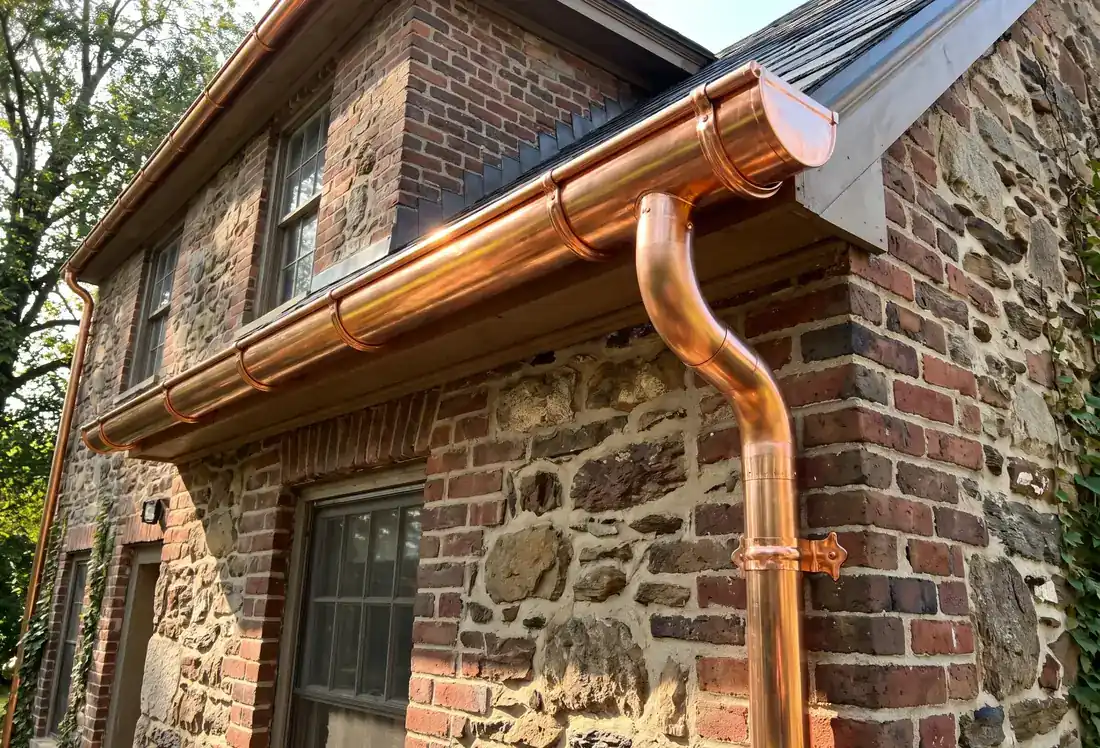
- Half-round copper on brackets: the traditional choice.
- K-style copper: a crisper look on Colonial Revival houses.
- Box gutters lined with copper on older buildings with built-in gutters.
Downspouts are usually round or plain rectangular copper, with matching straps.
How copper is installed
- Sectional lengths joined by lapping and soldering, not just sealant. Soldered joints last as long as the gutter.
- Copper brackets and fasteners, or compatible stainless steel. Dissimilar metals cause galvanic corrosion.
- Expansion joints on long runs, because copper moves with temperature.
- Careful handling, because fingerprints and scratches show until patina evens them out.
Things to watch
- Runoff staining. Water from copper can leave blue-green stains on light masonry or concrete below.
- Mixed metals. Do not let copper discharge onto galvanized or aluminum flashings or gutters below.
- Theft. Copper downspouts have scrap value. Some owners use copper gutters with painted aluminum downspouts at ground level.
- Guards. Use copper or stainless guards to avoid mixing metals.
Repair or replace
Copper systems are worth repairing. Joints can be resoldered, damaged sections replaced and brackets renewed. A contractor experienced with copper is important; sealant patches on copper rarely last.
Climate
In a humid climate with 48.27 inches of rain a year, copper patinas steadily. It handles freeze-thaw and the Triad's occasional ice storms well, though brackets must be sound because ice weight applies to any material.
Copper on historic High Point buildings
Copper drainage turns up on churches, older commercial buildings and the larger period-revival homes. Where it survives, it is usually worth a careful inspection before anyone suggests replacing it. Common findings:
- Failed solder joints that can be cleaned and resoldered.
- Loose or broken brackets, often iron, which may need replacing with copper or stainless.
- Thinned bottoms in box gutters after decades of standing water and debris.
- Mismatched repairs where aluminum or galvanized pieces were spliced in, causing corrosion at the contact points.
Repairs done with sealant and aluminum flashing on copper systems often fail quickly. Look for a contractor who solders.
Mixing copper with other materials
Some owners use copper only where it shows, such as on the front elevation or a bay window, and painted aluminum elsewhere. That can work if the two systems are kept apart, with no copper water running onto aluminum or galvanized steel. Downspout straps, fasteners and any guards should match the metal they touch.
Upkeep
Copper needs little. Keep it clean so water does not stand in it, check solder joints every few years, and leave the patina alone. Cleaning copper to keep it bright is possible but rarely worth the effort on a gutter.
What affects cost
- Copper weight (16 oz or 20 oz per square foot).
- Profile and size.
- Soldering and fabrication time.
- Matching downspouts, conductor heads and brackets.
- Height and access.
The materials guide compares copper with aluminum and steel.
Copper weights and details
| Specification | Common options | Notes |
|---|---|---|
| Copper weight | 16 oz or 20 oz per square foot | Heavier resists denting and lasts longer |
| Profile | Half-round or K-style | Half-round is traditional |
| Joints | Lapped and soldered | Solder outlasts sealant |
| Brackets | Copper or compatible stainless | Avoid galvanic corrosion |
| Downspouts | Round or plain rectangular copper | Matching straps |
| Conductor heads | Decorative boxes at the top of downspouts | Common on historic buildings |
Copper and local rainfall
Copper half-round has the same capacity limits as any half-round profile. At High Point's 10-year, 5-minute intensity of 6.97 inches per hour, plan outlets and downspout sizes carefully on large roofs.