
On this page
What downspouts do
The gutter collects. The downspout delivers. Every gallon that lands on your roof in a storm has to go down a downspout and out onto the ground. If there are too few, they are too small, or they empty in the wrong place, the best gutter in the world will still cause problems.
Sizes
- 2x3 inch rectangular: standard on many 5-inch systems. Fine for small roof areas.
- 3x4 inch rectangular: carries far more and clogs less. Standard with 6-inch gutters and a good upgrade on 5-inch systems under trees.
- Round 3-inch and 4-inch: used with half-round gutters.
Pine needles and oak catkins can bridge across a 2x3 outlet. Larger downspouts are one of the simplest ways to reduce clogs on wooded lots.
Placement
A contractor should place downspouts where:
- each run drains in a reasonable distance, usually no more than 30 to 40 feet;
- valleys and long roof planes have an outlet close by;
- water can discharge onto ground that falls away from the house;
- they will not empty onto walks, drives or steps that freeze;
- they look tidy on the elevation.
Where the water goes
This is the part most often skipped, and it matters more here than in many places.
Much of the land around High Point is Cecil-type soil: brown sandy loam on top and a red clay subsoil dominated by kaolinite beneath. Where topsoil has eroded, that red clay is at or near the surface. It takes water in slowly, so a downspout that dumps straight beside the foundation keeps the ground saturated and splashes red mud up the brick.
Options, from simplest:
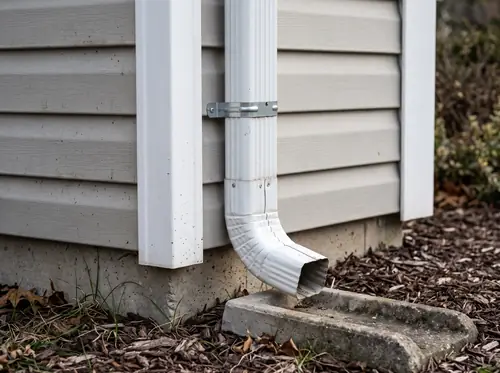
- Splash blocks on a positive slope away from the wall.
- Extensions, solid or flexible, carrying water 4 to 10 feet out.
- Hinged or flip-up extensions where mowing or paths are in the way.
- Underground pipe to a pop-up emitter or to daylight on a slope.
- Rain barrels or cisterns with an overflow led away from the house.
The downspout and foundation guide explains each.
Fixing downspouts properly
- Fasten with straps at top, middle and bottom. Loose downspouts rattle, separate and blow off in storms.
- Use elbows that point the outlet away from the wall, not along it.
- Crimp sections so the upper piece fits inside the lower, so water cannot run out of the joint.
- Avoid long horizontal runs across walls; they sag and clog.
Stormwater and your bill
The City of High Point charges a stormwater fee based on hard surface, including roofs. A typical residential account is billed for 2,588 square feet of impervious area, or one ERU, at $5 a month. The city maintains drainage within the public right-of-way; once runoff leaves it, the property owner is responsible for the drainage on their land. Sending downspout water onto a lawn or bed, rather than straight onto a driveway, helps it soak in.
Repair or replace
Dented, crushed or disconnected downspouts are cheap to replace. Buried drain lines that have filled with silt can sometimes be flushed or snaked; if they have collapsed, it is often better to bring the downspout above ground with an extension. See downspout repair.
Downspouts and the shape of the lot
High Point is hilly. The city sits at about 866 feet, with parts rising above 1,000, and many lots slope noticeably. That affects where downspouts can go:
- Lots sloping away from the house are easiest. Water discharged a few feet out keeps moving.
- Lots sloping toward the house need water carried around or past the building, sometimes with a swale or pipe to the low side.
- Split-level and walk-out houses often have one side well above grade and one at basement level. Downspouts on the uphill side need the most attention.
Rain barrels
A rain barrel on a downspout stores water for gardens and slows a little runoff. It needs an overflow that leads away from the house, because one summer storm can fill a barrel in minutes. Barrels also need emptying or draining before hard freezes. Many owners use a diverter that sends water to the barrel until it is full and then back down the downspout.
What affects cost
- Number and length of downspouts.
- 2x3, 3x4 or round.
- Extensions, splash blocks or underground drains.
- Height and access.
- Digging and restoring beds or lawn for buried lines.
Downspout capacity
| Downspout | Drainage area credited (This Old House) | Typical use |
|---|---|---|
| 2x3 rectangular | 600 sq ft | Smaller 5-inch runs |
| 3x4 rectangular | 1,200 sq ft | 6-inch gutters, wooded lots, large roofs |
| 3-inch round | Lower than 3x4 | Half-round systems |
| 4-inch round | Larger half-round systems | Historic and copper work |
Figures for rectangular downspouts are from This Old House's sizing guide. The Copper Development Association's handbook uses a different basis, 1,200 square feet of roof per square inch of downspout at 1 inch per hour; at High Point's 10-year, 5-minute intensity of 6.97 inches per hour, that is about 170 square feet per square inch.
Downspout parts
| Part | Job |
|---|---|
| Outlet or drop | Connects the gutter to the downspout |
| A and B elbows | Bend forward or sideways to follow the wall |
| Offset | Two elbows and a short piece to step around the eave |
| Straps | Hold the downspout to the wall |
| Bottom elbow | Turns water away from the house |
| Extension | Carries water further out |
| Splash block | Spreads the flow at the outlet |
| Leaf trap or clean-out | Catches debris before underground pipe |
| Pop-up emitter | Releases water from buried pipe onto the lawn |
Digging for buried drains
Underground downspout lines mean digging. North Carolina law requires three full working days' notice to NC811 before digging so utilities can mark buried lines, and locate marks stay valid for 28 calendar days. Call 811 or ask your contractor to do it.