
On this page
Sedgefield at a glance
| Where | Between Greensboro and High Point, along the old High Point Road |
| Status | A populated place within Greensboro, long outside city limits |
| ZIP code | 27407 |
| Country club | Sedgefield Country Club, host of the Wyndham Championship |
| Office campus | Pilot Life campus, opened 1928 |
| Biggest gutter risks | Large roofs, mature trees, long runs on estate houses |
Between two cities
Sedgefield grew up in the 1920s as a recreation-themed community between Greensboro and High Point. Preservation Greensboro notes that in 1928 the Pilot Life insurance company opened what it describes as North Carolina's first suburban office campus here, in a mixed-use community "located between two of the largest industrialized cities in North Carolina."
For decades it resisted incorporation and annexation. Its Wikipedia entry describes it today as a populated place within the city of Greensboro, ZIP code 27407. The Sedgefield Country Club hosts the Wyndham Championship, and the area was the first home of the Greater Greensboro Open golf tournament from 1938.
Housing
- Older estate homes near the club and the old inn, many from the community's early decades, with large footprints and traditional styles.
- Later sections built out over the following decades, mostly brick and two-storey.
- Newer developments on former woods and fields at the edges.
Lots are generally large and wooded.
What that means for gutters
Long runs and big roofs. Estate houses and large brick colonials have long eaves and large roof planes. Many need 6-inch gutters and plenty of downspouts.
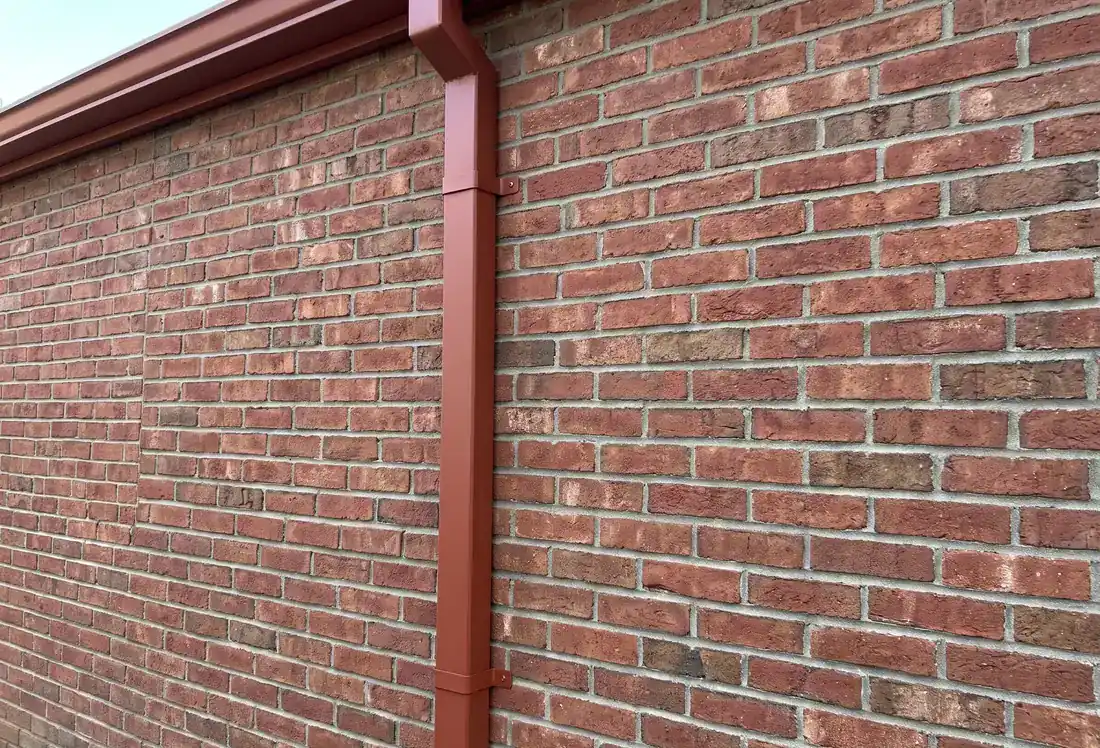
Traditional looks. Older brick houses may suit half-round or copper. Downspouts colored to match brick keep elevations tidy.
Trees. Golf-course and estate landscapes mean big oaks and pines. Guards and a cleaning schedule matter. See are gutter guards worth it.
Fascia on older homes. Check before replacing gutters. See fascia and soffit repair.
Drainage
Large roofs shed a lot of water. On a 3,000-square-foot roof, an inch of rain is nearly 1,900 gallons. Downspouts should carry it well clear of foundations and onto lawn or planted areas, especially where the subsoil is the red clay common across the Piedmont. Underground drains are common in established yards; check that they still flow. See downspout repair.
Weather
The area shares High Point's climate: around 48 inches of precipitation in a normal year, heavy summer storms and occasional freezing rain. Mature trees over large roofs are the main storm risk to gutters. See storm damage repair.
Common jobs in Sedgefield
- Upsizing on large brick colonials. Older houses here were often fitted with 5-inch gutters and 2x3 downspouts that cannot keep up with a big main roof in a summer storm. Replacing the main runs with 6-inch, or adding outlets at valleys, is a frequent fix.
- Replacing tired steel or early aluminum. Gutters from the middle decades of the last century may be galvanized steel, rusting at seams, or thin early aluminum on spikes.
- Clearing buried drains. Established yards often have downspouts piped underground to the lawn or a ditch. Silt, roots and needles block them, and the first sign is a gutter overflowing at the outlet.
- Guards under mature oaks and pines, chosen for the trees overhead.
Seasonal schedule
A sensible Sedgefield routine is a spring cleaning after oak catkins and pine pollen, a check after any major summer storm, and a thorough clean in early December once the oaks have dropped, before freezing-rain season. Homes backing onto the golf course or wooded common land usually need the full schedule; open lots may manage with one clean a year.
Getting quotes
On a large house, ask each contractor to break the quote down by elevation: gutter size, downspout count and length, guards and fascia allowances. It makes quotes comparable and shows whether anyone has skipped the valleys.
Storm intensity and gutter size in Sedgefield
NOAA's Atlas 14 gives point estimates of short-burst rainfall for Sedgefield. They are the right numbers for sizing gutters and downspouts here.
| Storm (NOAA Atlas 14) | Rainfall intensity |
|---|---|
| 2-year, 5-minute burst | 5.46 in/hr |
| 10-year, 5-minute burst | 6.94 in/hr |
| 100-year, 5-minute burst | 8.26 in/hr |
| 10-year, 60-minute storm | 2.21 in/hr |
Using the sizing method This Old House describes, which rates 5-inch K-style gutters at 5,520 adjusted square feet and 6-inch at 7,960, the 10-year figure works out roughly as:
| Gutter | Roof plane served at 6.94 in/hr (before pitch factor) |
|---|---|
| 5-inch K-style | about 795 sq ft |
| 6-inch K-style | about 1,145 sq ft |
| 5-inch half-round | about 360 sq ft |
| 6-inch half-round | about 555 sq ft |
Large brick colonials with long eaves are common. A 50-foot eave with a 22-foot-deep roof plane is 1,100 square feet, close to a 6-inch gutter's range at Sedgefield's 10-year rate, and past it once a pitch factor of 1.1 is applied, unless a second outlet is added.
Planning gutter work in Sedgefield
- Permits and local rules. Like-for-like gutter replacement rarely needs a permit, but fascia, structural or drainage changes might. Questions go to the City of Greensboro. Homeowners associations may also set color and style rules.
- Digging for drains. North Carolina requires three full working days' notice to NC811 before any digging, including burying downspout lines.
- Contractor checks. A state general contractor license applies only to projects of $40,000 or more. For typical gutter jobs, ask for insurance, a written itemized quote and the warranty in writing.
- Insurance. For storm or ice damage, photograph each side of the house from the ground before repairs and keep the contractor's itemized estimate.
Nearby areas
- Jamestown: the Quaker village to the west.
- Greensboro: the city to the north and east.
- Pleasant Garden: rural southeast Guilford.